

How to Tell If Coffee Beans Are Fresh: 7 Signs
Table of Contents
- The 7 Signs of Fresh Coffee Beans
- Why Roast Date Beats Expiration Date Every Time
- Coffee Roast Date vs Expiration Date: What the Label Actually Tells You
- How to Test Freshness by Sight, Smell, and Sound
- How Long Do Coffee Beans Actually Stay Fresh?
- The Best Way to Store Coffee Beans for Maximum Freshness
- How Long Does Cold Brew Stay Fresh?
- What Most People Get Wrong About Coffee Freshness
- Frequently Asked Questions
Last Updated: September 29, 2026
The 7 Signs of Fresh Coffee Beans
Learning how to tell if coffee beans are fresh comes down to one thing: the roast date. Fresh beans smell sweet and complex, feel dense, and release carbon dioxide when hot water hits them. Stale beans smell flat, look oily, and taste like cardboard. The seven signs below tell you which one you're holding.
This guide from Kaos coffee breaks down each sign, from the bloom test to the sound of the grind. By the end, you'll spot stale beans in seconds, without any special tools.
Why Roast Date Beats Expiration Date Every Time
The roast date tells you when the clock started ticking. The expiration date tells you almost nothing useful.
Most bags carry a "best by" date that sits six to twelve months out. That date assumes the beans were already sitting in a warehouse for weeks before shipping. It measures shelf stability, not flavor.
Roasted coffee starts losing its best qualities within days of roasting. So a bag stamped "best by" next March could already be past its peak the day you open it.
Check the roast date first. Always.
Coffee Roast Date vs Expiration Date: What the Label Actually Tells You
The coffee roast date vs expiration date question trips up almost every shopper. Here's the difference in plain terms:
- Roast date: the day the beans came out of the roaster. This is your real freshness clock.
- Expiration date: a manufacturer's guess at how long the sealed bag stays safe. It says nothing about flavor.
- Best by date: a marketing-friendly middle ground. Often six months or more after roasting.
A bag with only an expiration date is hiding something. If a roaster won't tell you when the beans were roasted, the answer is usually "a while ago."
How to Test Freshness by Sight, Smell, and Sound
Fresh coffee beans give you three quick clues before you ever brew them. Use your eyes, nose, and ears, then confirm with a brew test. Each sense catches a different stage of staling, so run all four checks in order.
Sight: Fresh beans look matte and even in color. Old beans look dull or overly shiny with oil on the surface. But oiliness alone is a trap, see the roast-level note below.
Smell: Fresh beans hit you with a sweet, complex aroma. Stale beans smell flat, dusty, or vaguely like hay. A useful trick: smell the beans, then smell the empty bag. If the bag smells stronger than the beans, the aromatics have already migrated out of the coffee.
Sound: Drop a few beans on a hard surface. Fresh beans click sharply. Stale beans sound soft and dull. This works because staling beans lose moisture and structural integrity, so they don't ring the same way.
Taste (the tiebreaker): If the first three checks are ambiguous, brew a small cup.
What Oiliness Actually Tells You
Oil on the surface is the most misread freshness signal. Dark roast beans release oils during roasting itself, so a shiny dark roast can be days old and perfectly fresh. Light and medium roasts stay matte for weeks. Oiliness only signals staleness when it appears on beans that started dry, that's oxidation pulling lipids to the surface. Judge oiliness against the bean's own baseline, not against a photo online.
The Bloom Test: Your Fastest Freshness Check
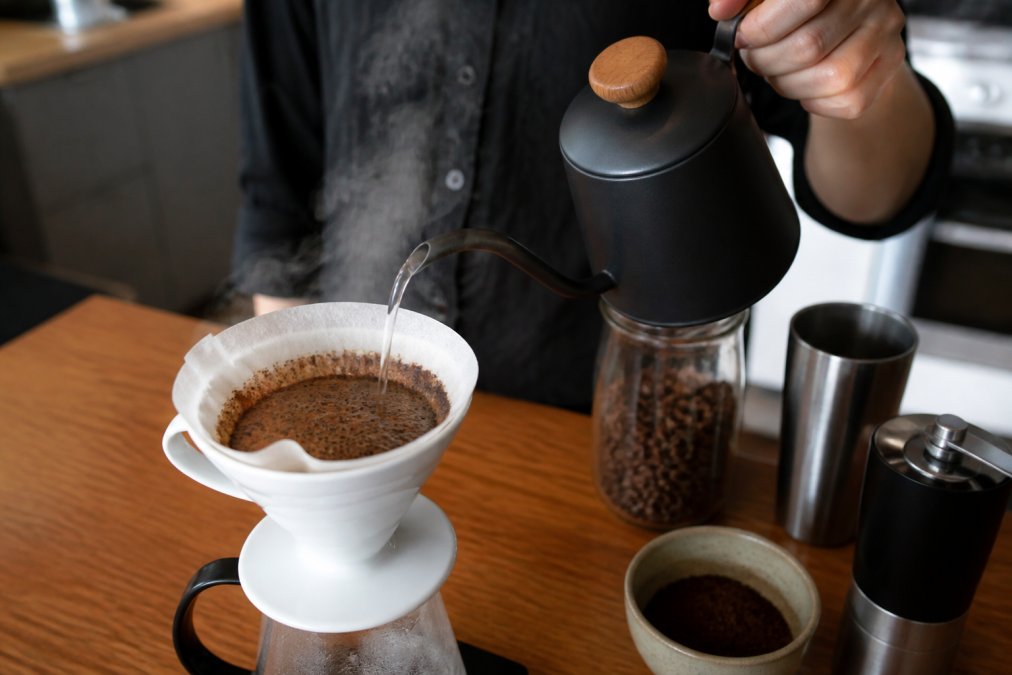
The bloom is the fastest freshness test you can run. Grind a scoop of beans, put them in a cup, and pour hot water over them.
- Use water just off the boil (about 200°F). Cooler water under-extracts and produces a weak bloom even on fresh beans.
- Grind medium. Too coarse and the water runs through without triggering a full bloom; too fine and it clogs.
- Watch the dome, not just the bubbles. Fresh beans form a tall, domed bed that rises and then collapses. Stale beans barely rise.
- Time it. A vigorous bloom typically lasts 20-40 seconds on fresh beans and fizzles in under 10 on stale ones.
How Long Do Coffee Beans Actually Stay Fresh?
Whole bean coffee tastes best within two to four weeks of the roast date. After that, oxidation slowly strips away the flavors you paid for.
Here's a rough timeline:
- Days 1-3: Resting period. Beans degas heavily and brew unevenly.
- Days 4-14: The freshness window. Peak flavor profile and aroma.
- Weeks 3-6: Still good, but brightness and acidity fade.
- Past 6 weeks: Noticeably stale. Flat taste, dull smell.
The Best Way to Store Coffee Beans for Maximum Freshness
The best way to store coffee beans is in an airtight container kept cool, dark, and away from moisture. Get those three right and you'll protect flavor for weeks. But storage isn't just about keeping beans 'safe', it's about hitting the peak flavor window before oxidation and degassing strip the good stuff out.
The Peak Flavor Window vs. 'Still Drinkable'
There's a difference between coffee that's safe to drink and coffee at its peak. Most practitioners find whole beans hit peak flavor roughly 7 to 21 days after the roast date. Before day 7, beans are still degassing heavily and can brew unevenly. After about three weeks, brightness and acidity start fading even if the coffee still tastes fine. So 'fresh' isn't a yes/no, it's a curve, and storage decides how fast you slide down it.
What Actually Accelerates Staling
Four forces drive flavor degradation:
- Oxygen, oxidizes oils and aromatics. The single biggest factor once the bag is open.
- Moisture, triggers hydrolysis and off-flavors. Beans are hygroscopic, so they pull water from humid air.
- Light, UV breaks down aromatic compounds. Clear jars on a sunny counter are the worst offender.
- Heat, every 10°F of extra warmth speeds up chemical reactions. A warm cabinet beats a countertop next to the stove.
Roast Level and Processing Change the Clock
Not all beans stale at the same rate:
- Dark roasts degas faster and oxidize faster. They're often best within 1-2 weeks.
- Light roasts hold up longer, sometimes 3-4 weeks, because their denser structure and lower oil migration slow oxidation.
- Natural (dry-processed) beans tend to be fruitier and can show staling as a loss of that fruit character first.
- Washed beans often reveal staleness as a flat, papery taste.
- High-altitude, denser beans generally stale more slowly than softer, lower-grown beans.
Match your storage plan to the bean, not to a generic rule.
What to Avoid
- Clear glass jars on a sunny counter (light exposure kills aroma)
- The fridge (moisture swings and food odors)
- The freezer door (temperature changes every time you open it)
A one-way valve on the bag lets carbon dioxide out without letting air in. Keep beans in that bag, or move them to a sealed canister.
Freezing: The Right Way
For longer storage, freezing whole beans in a vacuum sealed bag works well. Freeze in small portions so you only thaw what you'll use. Two rules matter here:
- Freeze whole beans, not ground. Grinding exposes far more surface area to oxygen.
- Thaw sealed, then grind. Opening a frozen bag lets condensation form on the beans, which introduces moisture.
How Long Does Cold Brew Stay Fresh?
How long does cold brew stay fresh? Cold brew concentrate keeps about one to two weeks in the fridge. Ready-to-drink cold brew is best within three to five days.
Signs your cold brew has turned:
- A sour or flat taste
- A dull, muddy smell
- Visible separation or cloudiness
What Most People Get Wrong About Coffee Freshness
Most people trust the expiration date and ignore the roast date. That's the biggest mistake.
Here's what actually matters:
- Buy smaller amounts more often. Freshness beats bulk.
- Check the roast date before you buy, every time.
- Grind right before brewing to protect the flavor profile.
- Store beans right to slow oxidation and rancidity.
Frequently Asked Questions
How long do coffee beans actually stay fresh after roasting?
Whole coffee beans hit peak flavor about 4 to 14 days after roasting. After that, they gradually lose aroma and complexity. Most beans stay decent for 4 to 6 weeks if stored in an airtight container away from light and heat. Past two months, you will notice flat flavor, weak aroma, and a dull bloom. The roast date on the bag is your best guide, not the expiration date.
Can you tell if coffee beans are fresh by the smell alone?
Smell is one of the fastest checks. Fresh beans release a strong, complex aroma the moment you open the bag. If the beans smell like cardboard, paper, or almost nothing, they have lost most of their volatile compounds. Stale beans also lose their sweetness and brightness. For a sharper read, grind a small amount and smell again, since grinding releases more aroma.
What is the best way to store coffee beans to keep them fresh?
Use an airtight, opaque container and keep it in a cool, dark spot away from the stove, oven, or sunny windows. A one-way valve bag works well too because it lets carbon dioxide escape without letting oxygen in. Avoid the fridge for daily use since moisture and odors creep in. For longer storage, freeze beans in a vacuum-sealed bag and grind them straight from frozen.
How long does cold brew stay fresh in the fridge?
Cold brew concentrate keeps about 7 to 10 days in the fridge, while ready-to-drink cold brew stays fresh for roughly 3 to 5 days. Store it in a sealed glass jar or bottle to slow oxidation. If it starts tasting sour, flat, or fizzy, toss it. Adding a splash of milk shortens the window further, so drink milk-based cold brew within 2 days.
Stale coffee is a daily letdown, and most people never realize the bag is the problem. Kaos coffee roasts to order, so your beans ship at their peak instead of sitting in a warehouse. Our lineup of blends, single-origin beans, and convenient pods delivers maximum flavor and aroma, with fast, reliable delivery built for a busy schedule. Get started with Kaos coffee and taste what fresh-roasted actually means.